Baseline Surface Radiation Network (BSRN)#
Description#
The objective of the BSRN is to provide observations of the best possible quality for short- and long-wave surface radiation fluxes with a high sampling rate. These readings are taken from a small number of selected stations, in contrasting climatic zones, together with collocated surface and upper air meteorological data and other supporting observations.
The uniform and consistent measurements throughout the BSRN network are used to:
monitor the background (least influenced by immediate human activities which are regionally concentrated) short-wave and long-wave radiative components and their changes with the best methods currently available,
provide data for the validation and evaluation of satellite-based estimates of the surface radiative fluxes and
produce high-quality observational data for comparison to climate model (GCM) calculations and for the development of local regionally representative radiation climatologies.
Source: WRMC on the objectives of GHCNh (last accessed 2026-03-10)
Relational schema#
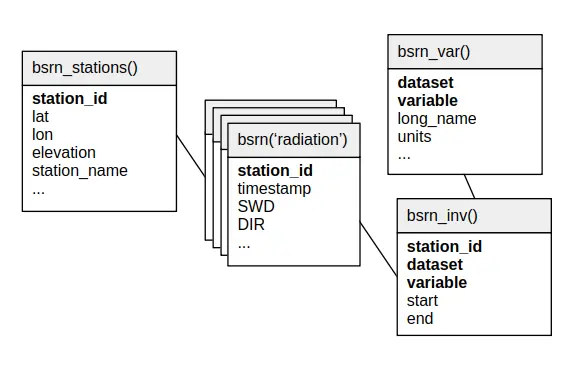
Below is the relational schema of BSRN in SEASTERS.
Variable overview#
Four dataset types are included in the database, although not all stations provide each of them.
This is the core dataset of BSRN, with “basic measurements of radiation”.
Query:
SELECT variable, long_name, units
FROM bsrn_var()
WHERE dataset == 'radiation'
ORDER BY variable
Response:
┌─────────────┬────────────────────────────────────────────────────────────┬─────────┐
│  variable   │                         long_name                          │  units  │
│   varchar   │                          varchar                           │ varchar │
├─────────────┼────────────────────────────────────────────────────────────┼─────────┤
│ DIF         │ Diffuse radiation                                          │ W/m**2  │
│ DIF max     │ Diffuse radiation, maximum                                 │ W/m**2  │
│ DIF min     │ Diffuse radiation, minimum                                 │ W/m**2  │
│ DIF std dev │ Diffuse radiation, standard deviation                      │ W/m**2  │
│ DIR         │ Direct radiation                                           │ W/m**2  │
│ DIR max     │ Direct radiation, maximum                                  │ W/m**2  │
│ DIR min     │ Direct radiation, minimum                                  │ W/m**2  │
│ DIR std dev │ Direct radiation, standard deviation                       │ W/m**2  │
│ LWD         │ Long-wave downward radiation                               │ W/m**2  │
│ LWD max     │ Long-wave downward radiation, maximum                      │ W/m**2  │
│ LWD min     │ Long-wave downward radiation, minimum                      │ W/m**2  │
│ LWD std dev │ Long-wave downward radiation, standard deviation           │ W/m**2  │
│ PoPoPoPo    │ Station pressure                                           │ hPa     │
│ RH          │ Humidity, relative                                         │ %       │
│ SWD         │ Short-wave downward (GLOBAL) radiation                     │ W/m**2  │
│ SWD max     │ Short-wave downward (GLOBAL) radiation, maximum            │ W/m**2  │
│ SWD min     │ Short-wave downward (GLOBAL) radiation, minimum            │ W/m**2  │
│ SWD std dev │ Short-wave downward (GLOBAL) radiation, standard deviation │ W/m**2  │
│ T2          │ Air temperature at 2 m height                              │ °C      │
├─────────────┴────────────────────────────────────────────────────────────┴─────────┤
│ 19 rows                                                                  3 columns │
└────────────────────────────────────────────────────────────────────────────────────┘
Some stations provide this additional dataset, with “other measurements at 10 m”.
Query:
SELECT variable, long_name, units
FROM bsrn_var()
WHERE dataset == 'radiation_10m'
ORDER BY variable
Response:
┌──────────┬──────────────────────────────────────┬─────────┐
│ variable │              long_name               │  units  │
│ varchar  │               varchar                │ varchar │
├──────────┼──────────────────────────────────────┼─────────┤
│ LWU      │ Long-wave upward radiation           │ W/m**2  │
│ SWU      │ Short-wave upward (REFLEX) radiation │ W/m**2  │
└──────────┴──────────────────────────────────────┴─────────┘
“Radiosonde measurements” are indexed by a pair of timestamp and Altitude
fields, providing measurements along a vertical axis above the station.
Query:
SELECT variable, long_name, units
FROM bsrn_var()
WHERE dataset == 'radiosonde'
ORDER BY variable
Response:
┌──────────┬─────────────────────────────┬─────────┐
│ variable │          long_name          │  units  │
│ varchar  │           varchar           │ varchar │
├──────────┼─────────────────────────────┼─────────┤
│ Altitude │ ALTITUDE                    │ m       │
│ PPPP     │ Pressure, at given altitude │ hPa     │
│ TTT      │ Temperature, air            │ °C      │
│ TdTdTd   │ Dew/frost point             │ °C      │
│ dd       │ Wind direction              │ deg     │
│ ff       │ Wind speed                  │ m/s     │
└──────────┴─────────────────────────────┴─────────┘
Some stations lastly provide “meteorological synoptical observations”.
Query:
SELECT variable, long_name, units
FROM bsrn_var()
WHERE dataset == 'SYNOP'
ORDER BY variable
Response:
┌──────────┬───────────────────────────────────────┬─────────┐
│ variable │               long_name               │  units  │
│ varchar  │                varchar                │ varchar │
├──────────┼───────────────────────────────────────┼─────────┤
│ CH       │ High cloud                            │ code    │
│ CL       │ Low cloud                             │ code    │
│ CM       │ Middle cloud                          │ code    │
│ N        │ Total cloud amount                    │ code    │
│ Nh       │ Low/middle cloud amount               │ code    │
│ PPPP     │ Station pressure reduced to sea level │ hPa     │
│ TTT      │ Temperature, air                      │ °C      │
│ TdTdTd   │ Dew/frost point                       │ °C      │
│ VV       │ Horizontal visibility                 │ code    │
│ dd       │ Wind direction                        │ deg     │
│ ff       │ Wind speed                            │ m/s     │
│ h        │ Cloud base height                     │ code    │
│ ww       │ Present weather                       │ code    │
├──────────┴───────────────────────────────────────┴─────────┤
│ 13 rows                                          3 columns │
└────────────────────────────────────────────────────────────┘
Important
Items of the variable columns above are the fields (column names) of the main
table’s data records in bsrn().
How to cite?#
In the BSRN network, one PI is assigned to one station for a given period: depending on
the station and period you look up to, the citation to use is not the same.
Furthermore, some station records are not grouped into collections and were thus retrieved
from monthly individual datasets, making many references to cite. The BSRN Data Release
Guidelines are nevertheless
clear: “the use of a particular station’s data and the World Radiation Monitoring
Center (WRMC) must always be explicitly acknowledged (= cited)”. So… brace
yourself, and you can download the full list of citations from the following:
bsrn_citations.txt.
In case you want to cite BSRN in general (although it remains mandatory to cite the exact datasets you use), you can cite Driemel et al. (2018).
References#
Amelie Driemel, John Augustine, Klaus Behrens, Sergio Colle, Christopher Cox, Emilio Cuevas-Agulló, Fred M. Denn, Thierry Duprat, Masato Fukuda, Hannes Grobe, Martial Haeffelin, Gary Hodges, Nicole Hyett, Osamu Ijima, Ain Kallis, Wouter Knap, Vasilii Kustov, Charles N. Long, David Longenecker, Angelo Lupi, Marion Maturilli, Mohamed Mimouni, Lucky Ntsangwane, Hiroyuki Ogihara, Xabier Olano, Marc Olefs, Masao Omori, Lance Passamani, Enio Bueno Pereira, Holger Schmithüsen, Stefanie Schumacher, Rainer Sieger, Jonathan Tamlyn, Roland Vogt, Laurent Vuilleumier, Xiangao Xia, Atsumu Ohmura, and Gert König-Langlo. Baseline Surface Radiation Network (BSRN): structure and data description (1992–2017). Earth System Science Data, 10(3):1491–1501, August 2018. doi:10.5194/essd-10-1491-2018.